

“What [matters] even today in the AI world is the experience you bring with you. AI can do the code, but it cannot build the ecosystem you want for your customers.”
Ajith Shetty, Fabric Spark Engineering
“I would use them as an assistant, not as a replacement for me to do the critical thinking.”
Amanjeet Singh, Fabric Customer Advisory Team
Fabric has become a platform for agents.
Have our settings kept up?
Fabric before Barcelona
New features labeled GA or preview
The roadmap, no spin
Where to start
OneLake in the center. The workloads sit around it: Lakehouse, Warehouse, Real-Time Intelligence, Power BI, Data Factory.
Copilot and the data agent lived inside the ring. We asked in Fabric, and the answer stayed in Fabric.
The “Fabric data in Microsoft Copilot” setting in the Microsoft 365 admin center, on by default for everyone.
Anyone with read-only access can use Copilot, Copilot Chat, Cowork, the data agent, and MCP tools. On by default.
The setting doesn't carry over to chained models, the ones built on top of this model.
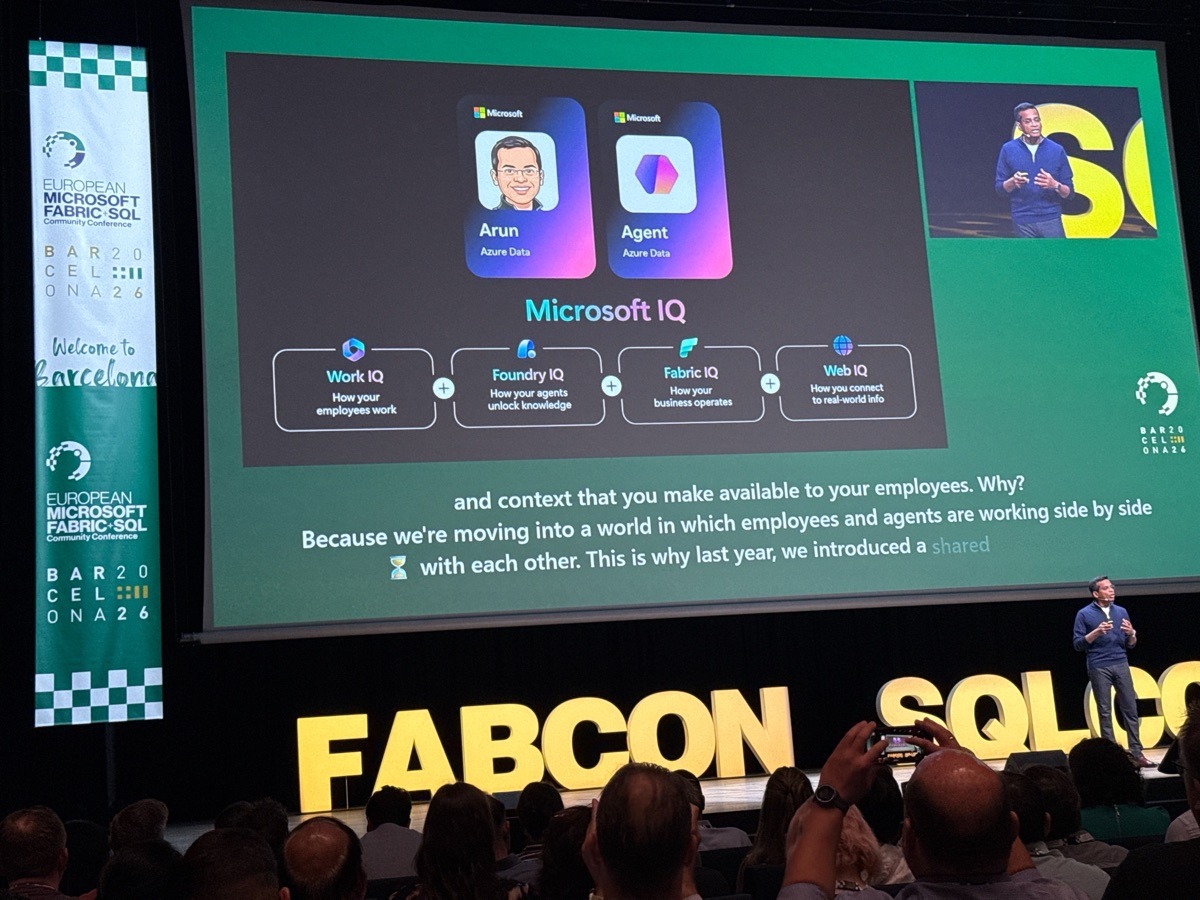
A user asks in the chat, and Fabric IQ answers from a semantic model we control.
An MCP client queries Fabric IQ. Core MCP creates workspaces and items on the user's behalf.
A data agent works as a tool for another agent. An app reads Delta and Iceberg tables over REST, and OneLake security filters the result.

We ask a business question in Copilot Chat, and the answer comes from a semantic model we control. No extra charge for AI tokens.
In practice: queries from the chat still use our capacity. There's just no separate bill for tokens.
Limit: the answer is only as good as the descriptions and synonyms in the model. The “code experience” version goes to the Frontier program first.
Reads. Six tools, all read-only: search, model schema, DAX query. The answer comes from the data and respects the user's permissions.
Changes. 27 tools, and 15 of them write changes to workspaces, items, and permissions. Sign-in uses OAuth 2.0 with Entra ID, and Fabric logs supported operations in the audit log.
Learn: “Autonomous or misconfigured clients may perform destructive actions.” Safeguards against destructive operations aren't standardized in MCP, and a client can process data outside Fabric's compliance boundaries.

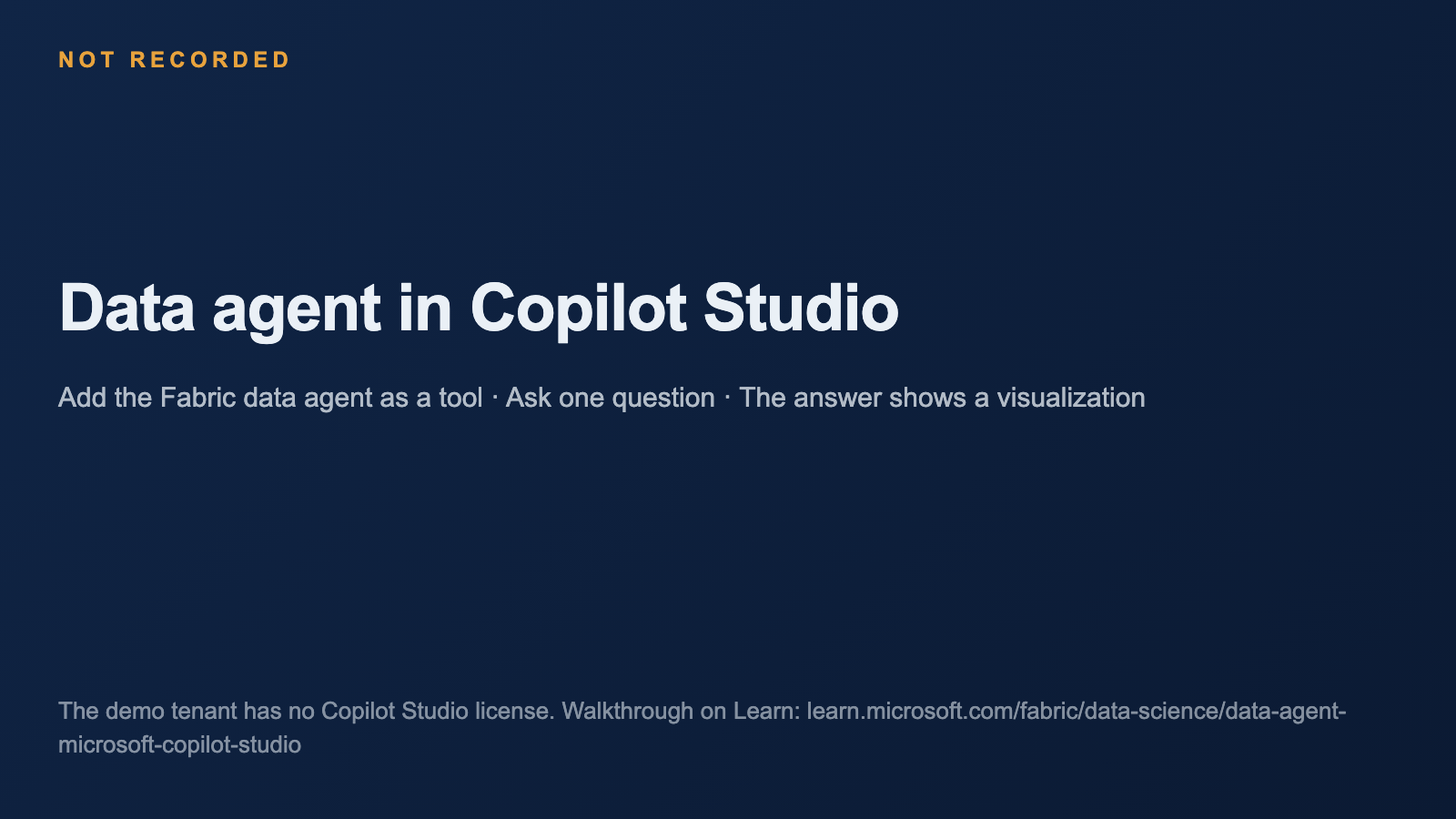
A Fabric data agent works as a tool for an agent in Copilot Studio and shows a visualization in its answer.
Keynote: GA. The Learn walkthrough still says preview on October 21, 2026. Topics in data agents are in preview too.
An app reads a Delta or Iceberg table over REST, and OneLake security filters rows and columns on every request.
In practice: any app that sends an HTTP request with an Entra ID token can read the table. No Spark cluster, no SQL endpoint, no copy of the data. OneLake security permissions are the only guard.
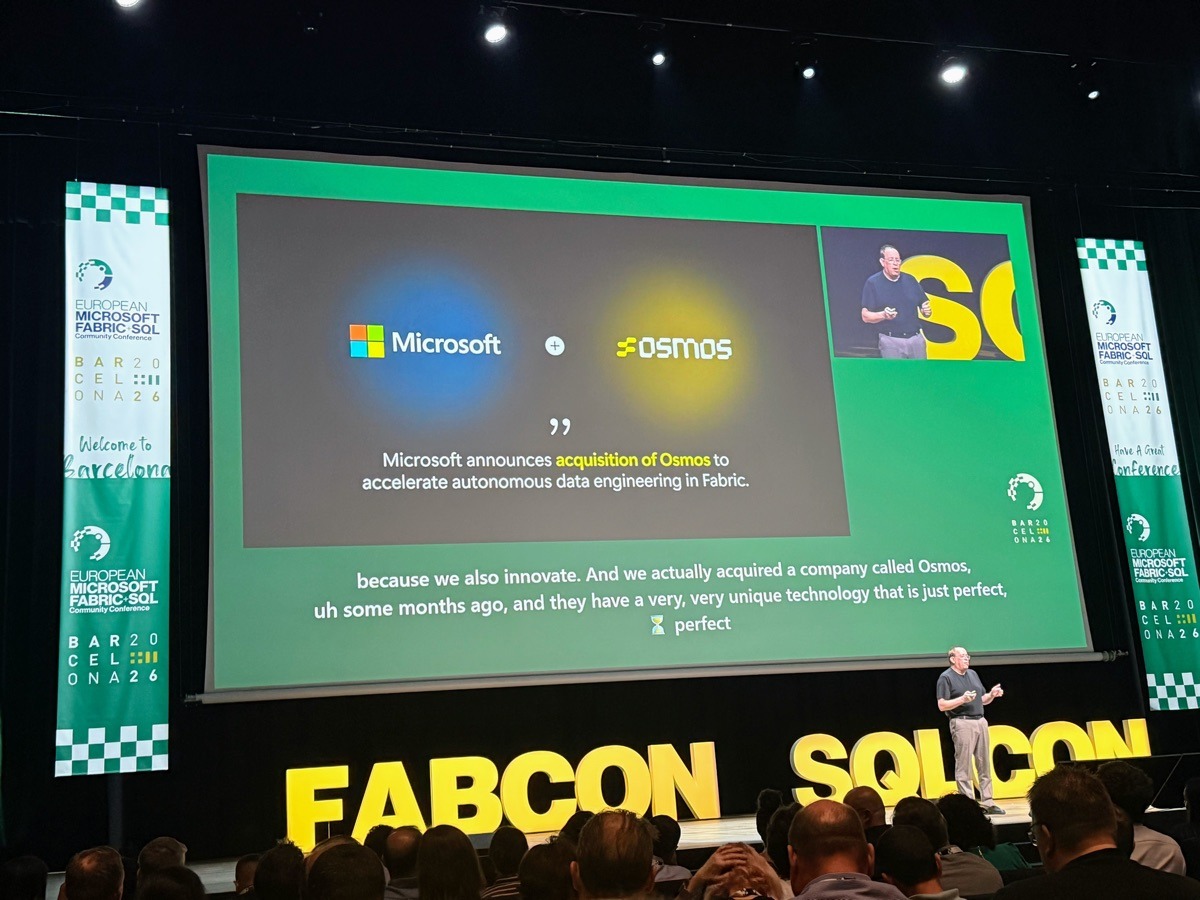
The agent plans, runs, and validates a data engineering task in Fabric on SparkCore. We start it from GitHub Copilot CLI, Claude Code, or Codex. Tasks persist, so we can come back to them.
Guardrails: a permission boundary, a write pattern, rerun rules, schema evolution. Fabric and OneLake permissions decide what the agent can do.
The agent works out why a pipeline run failed, straight from Monitor hub.
Read-only, on behalf of the signed-in user. Needs the Contributor role and workspace monitoring turned on.

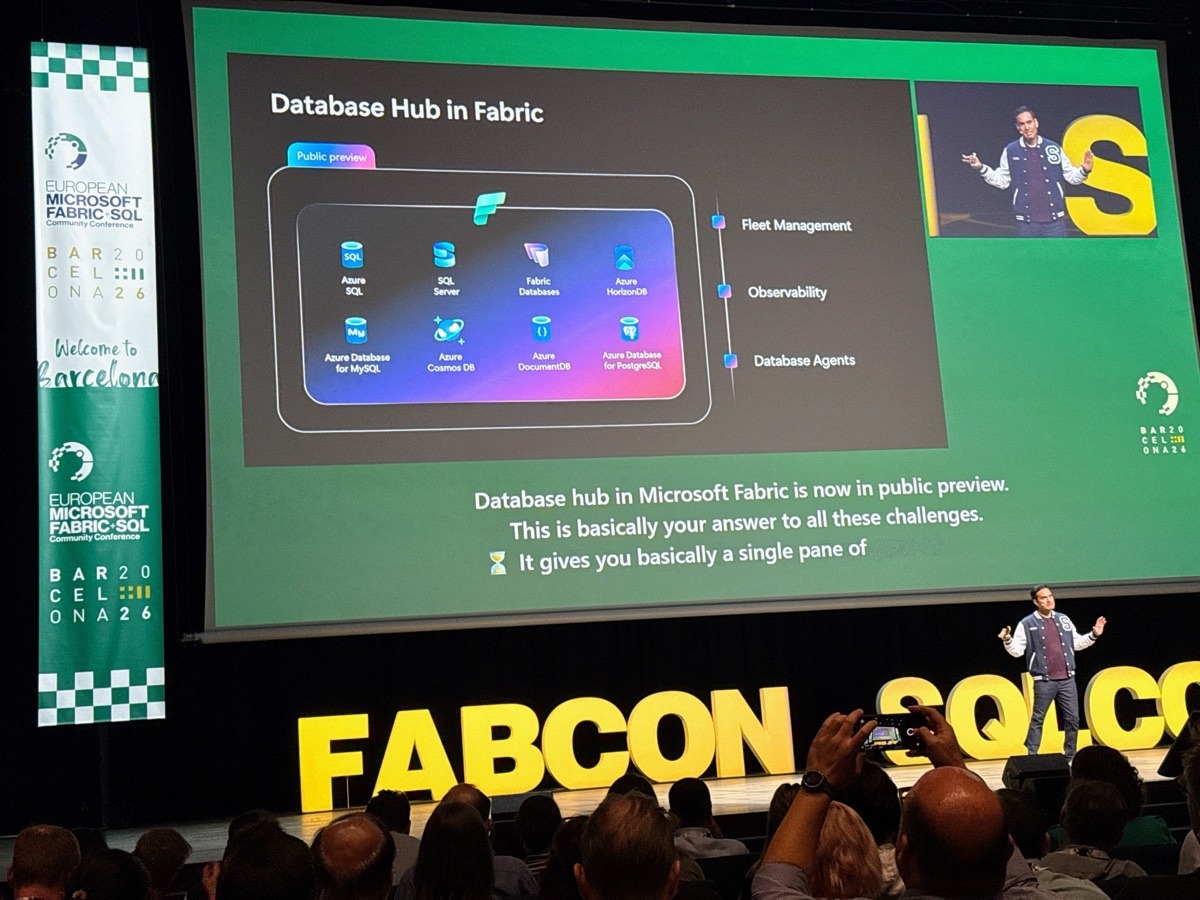
For SQL and PostgreSQL, in Database Hub and in VS Code. Announced at the keynote, not available yet.
Database Hub itself is in preview too.
We build the ontology from a semantic model, data in OneLake, and documents. We write rules in natural language. DAX measures come in as metrics. The ontology agent acts on our behalf and respects OneLake security, RLS, OLS, and CLS.
In practice: we export to RDF and Turtle, the W3C standards for knowledge graphs, and we can import from OWL. Another graph tool can open an ontology from Fabric.
The previous ontology version goes away on January 31, 2027, and the new one replaces it. An independent review flagged entities without an identifying key and no automatic health check for the ontology.

We describe the app, and Power BI Desktop generates it, previews it, and publishes it. Included with Pro and PPU licenses, up to 1 GB per app, with write-back.
A Real-Time Dashboard from one sentence, and we manage the eventhouse in natural language.
Roles, RLS, and CLS in one place, also through shortcuts. Every lakehouse gets a DefaultReader role. GA announced for the coming weeks, with no specific date.
The workspace won't let data out, either through an outbound shortcut or through a data agent.
Blocks access for everyone, or just for guests, when it finds sensitive data in a Fabric item.
Scope: tenant or capacity. It's an allow list only: the only effect is Allow, and there's no Deny. Conditions: workspace, groups, sensitivity labels, recipient domain, item type.
One screen for the admin: label coverage, DLP results, tenant settings, recommended actions.
The data refreshes once a day. The view doesn't cover tables inside items.
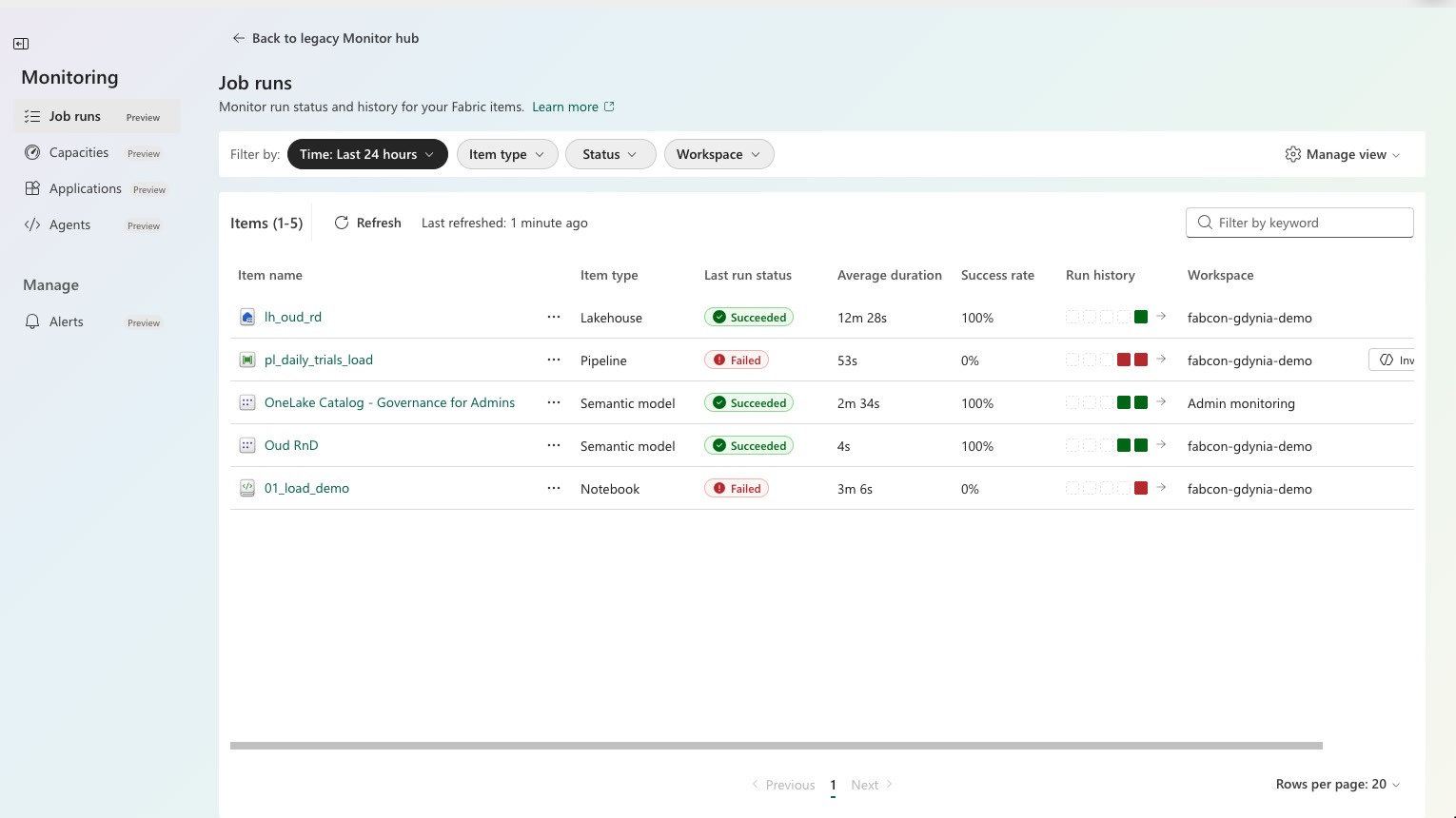
The new Monitor hub: run history and success rate for every job. Plus workspace monitoring in an eventhouse and Activator alerts.
| What | Status |
|---|---|
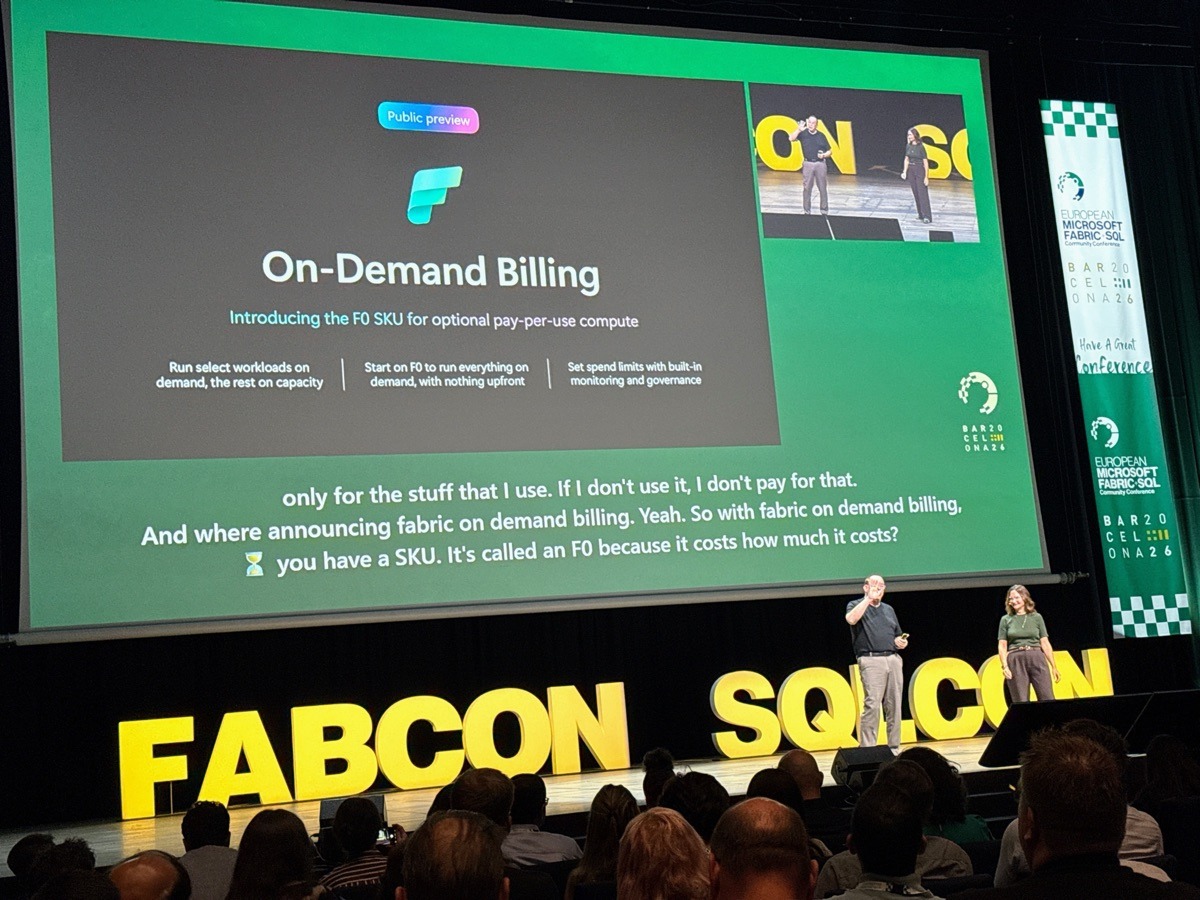
| ROADMAPOn-demand billing and F0 capacity | Soon, no pricing yet |
| ROADMAPDatabase agents for SQL and PostgreSQL | Soon |
| ROADMAPNative support for ontologies and semantic models in IQ sharing | On the roadmap |
| ROADMAPApache Ossie, a vendor-neutral ontology standard, together with Snowflake | Announced |
| ROADMAPGA date for OneLake security | Not given |
| ROADMAPPrevious ontology version | Retired January 31, 2027 |
Microsoft 365 admin center, Copilot settings, “Fabric data in Microsoft Copilot”. Let's check who has access.
Let's check the AI setting on semantic models with HR and finance data. It doesn't carry over to chained models.
Let's check the tenant settings that let AI process data outside the capacity's region and geography.
Let's turn on outbound access protection for workspaces with sensitive data.
Let's test RLS under the data agent on our own model. Learn says the agent respects RLS and CLS. But there's an unconfirmed report on Microsoft Q&A that the agent returned unfiltered rows. Let's check for ourselves.
Let's tag preview items before someone puts them into production.
The agent acts on the user's behalf, with least privilege, and read-only. It respects Purview DLP. The agent can't see more than the user.
Let's ask Microsoft whether the agent can run under its own Entra Agent ID instead of as the user. No answer yet.
Fabric has become a platform for agents.
Have our settings kept up?
Projects: data platforms and lakehouses, data modeling and reporting, AI and automation. Microsoft Fabric, Azure, Databricks, Power BI.
We don't do body leasing. We run projects, and staff augmentation happens very, very rarely.

POST /v1/catalog/search searches by name, description, and workspace name, with a type filter. It returns only what we have permission to see. The search_catalog tool in Core MCP runs the same search.
In practice: an agent first checks whether a model or table already exists, before it builds another copy.
ai.translate, ai.analyze_sentiment, and ai.classify on tester comments written in English, Arabic, and French. Built-in Fabric endpoint, no API key.
In practice: we process text where the data lives, with no separate service and no copying.
On Runtime 2.0 you have to name the model explicitly for now. Learn documents this as a temporary workaround.
We create the silver and gold layers with CREATE MATERIALIZED LAKE VIEW. Fabric builds the lineage and refreshes views in dependency order. CONSTRAINT … ON MISMATCH DROP rejects bad rows.
In practice: three bad rows from the panel never reached the gold layer. The run report shows Dropped rows: 3.
Views created from PySpark are in preview and only do full refreshes.
An agent on lh_oud_rd with instructions in English. Both answers match the data: OB-104 Oud Saffron S-7, 68%, 14,353 QAR per kilogram.
In practice: we test the agent with questions we already know the answer to.
With the vaguer question “Which formula beats the reference most often?”, the agent counted winning trials and named the wrong formula. Each formula has only about one trial.
The onelake.table.fabric.microsoft.com endpoint: Delta through a Unity Catalog compatible API, Iceberg through the Iceberg REST Catalog. A Delta table from the lakehouse shows up as Iceberg format-version 2.
In practice: any engine that speaks Iceberg REST or Unity Catalog sees our tables with no copy and no export.